


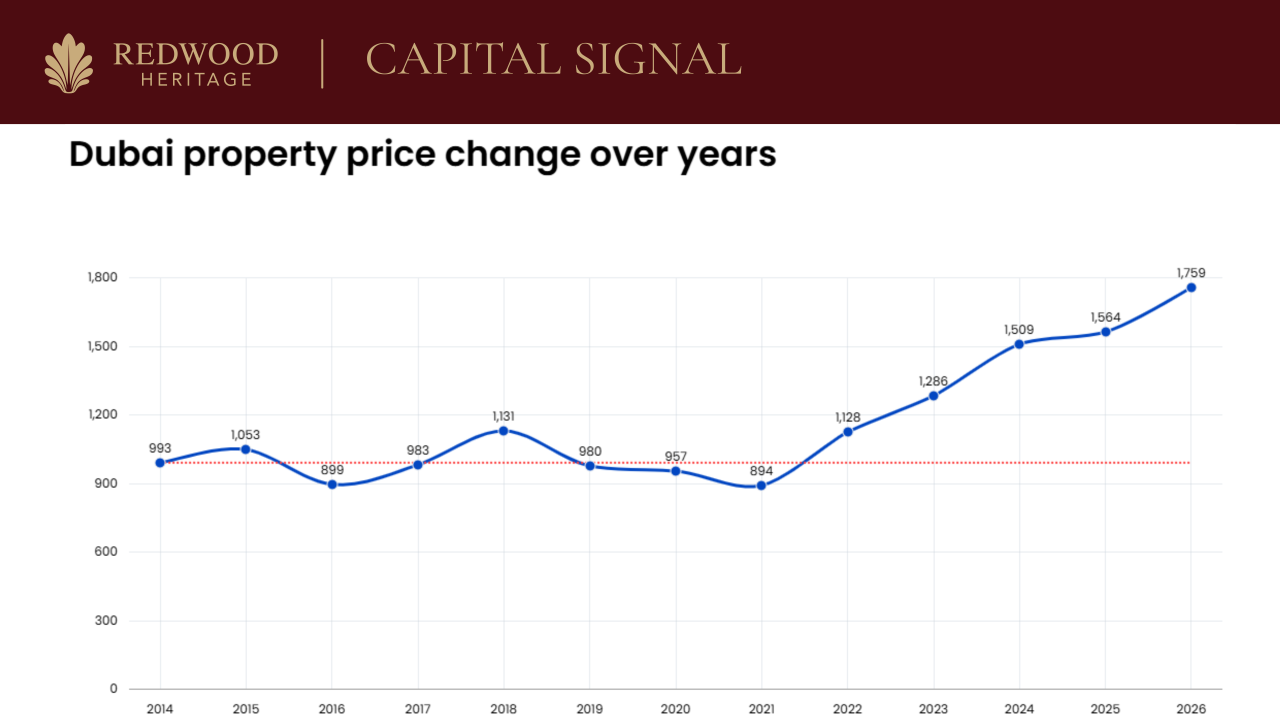
Dubai residential prices have moved from approximately AED 894 per sq ft in 2021 to AED 1,759 per sq ft in 2026. That represents an increase of around 97% in five years.
The first conclusion is straightforward: this has not been a marginal recovery. It has been a material repricing of Dubai residential real estate.
The second conclusion is more relevant for capital allocation: this repricing has occurred through a difficult external environment.
Since 2021, investors have had to navigate higher global interest rates, tighter liquidity, inflation volatility, a stronger US dollar, shifting capital flows and repeated geopolitical shocks. The current regional situation is serious. War is not a market variable to be treated lightly. Diplomacy must prevail.
But from an investment perspective, the distinction between event risk and structural demand remains essential.
Event risk can affect sentiment, delay transactions and create short-term pricing hesitation. Structural demand determines whether capital returns once uncertainty begins to clear.
Dubai’s resilience is increasingly linked to the second category.
The market is no longer supported only by cyclical liquidity or short-term speculative flows. Its demand base has broadened through population growth, business migration, wealth relocation, residency demand, infrastructure depth, safety, tax efficiency and the continued arrival of international families and entrepreneurs seeking a stable operating and living environment. This does not remove volatility, that is a fact, but it does not mean prices move in a straight line.
It does suggest that Dubai has developed a stronger capacity to absorb external shocks, recalibrate and remain relevant to global capital. That distinction matters today.
In periods of geopolitical stress, weaker markets depend on confidence returning quickly. Stronger markets can withstand delayed decisions because the underlying reasons for allocation remain intact.
For Dubai, the current challenge is therefore not whether uncertainty exists. It clearly does.
The question is whether the structural case remains strong enough for capital to re-engage once visibility improves.
Our ongoing engagement with local and international investors since the outbreak of the war, supported by recent market data, suggests that underlying capital sentiment remains constructive.
However, we believe the next phase should not be approached with the same mindset as the recovery phase.
After a near doubling in five years, broad market exposure is less attractive than disciplined asset selection. Entry price, rental depth, location quality, end-user demand, scarcity, service charge efficiency and exit liquidity will matter more than headline market momentum.
The market can remain resilient while becoming more selective.
That is usually what happens when a maturing real estate market moves from recovery to institutionalisation. Therefore, capital will not reward every building equally. It will reward assets with defensible cash flow, durable demand and credible liquidity under stress.
In conclusion, the current geopolitical backdrop is a genuine test of confidence. Yet Dubai’s five-year price performance suggests that the market has developed a deeper resilience than in previous cycles.
Resilience does not mean the absence of volatility. It means the ability to absorb volatility without losing long-term capital relevance.
This is where informed advice becomes critical. In a market that has already repriced significantly, value is no longer created by access alone, nor by transaction volume. It is created through disciplined selection, price judgment, asset quality assessment and a clear understanding of liquidity under stress.
At Redwood Heritage Real Estate, our role is not simply to intermediate transactions. It is to help clients interpret the market, identify resilient assets and make property decisions within a broader capital and wealth preservation framework.

