


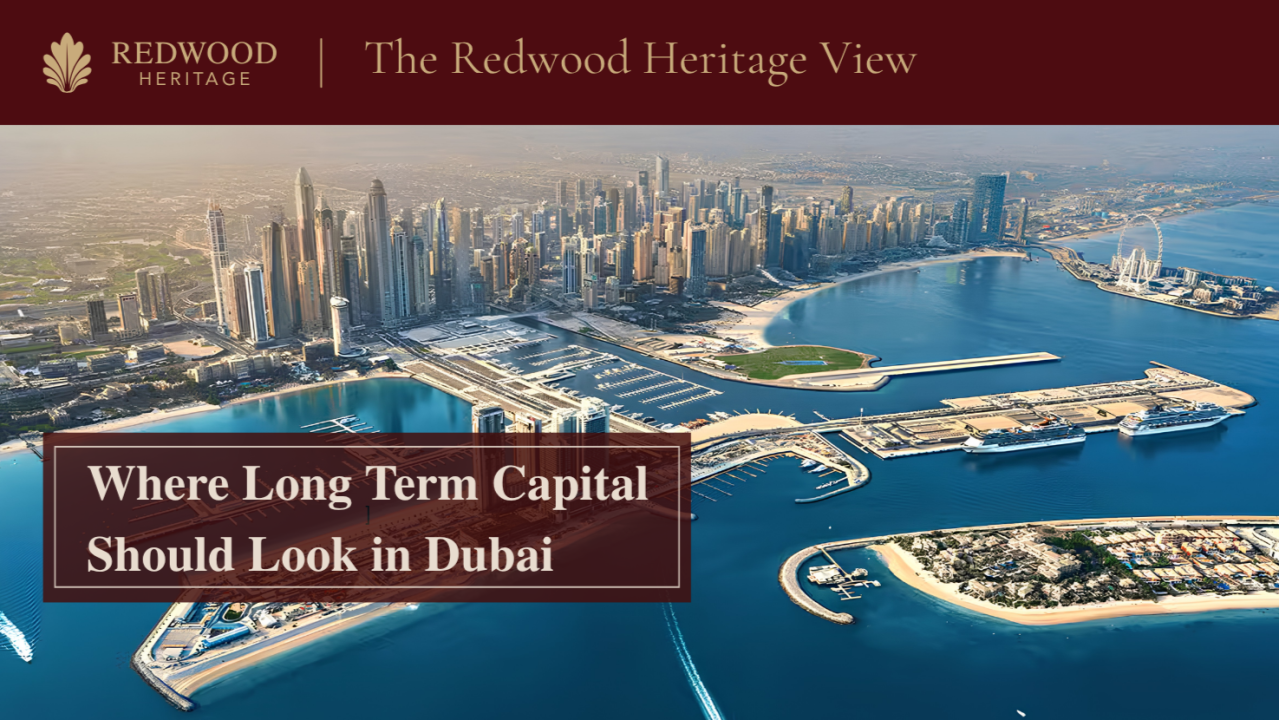
Dubai belongs in a global property allocation. That conviction has only been reinforced by our recent engagement with a growing number of international clients, including against a more complex regional backdrop. The question is no longer whether to allocate, but how to deploy capital with discipline: selecting the right submarkets, entering at the right valuation, and defining the role each asset should play within a broader wealth architecture.
That distinction has shaped Redwood Heritage’s recent market thinking across a series of connected signals. In 120 Family Offices, $1.2 Trillion: What They’re Telling Us About a Shifting Dubai Market, we examined how global private wealth is becoming more selective in Dubai. In Dubai Property Shifts Towards Buyer’s Market for First Time in Years, we identified the return of price discovery after years of broad market momentum. In Dubai Real Estate Market View | Q1 2026, we showed how headline strength is giving way to more asset specific performance. In Dubai’s Gold Line: A Signal of Confidence During Uncertainty, we framed infrastructure as a long term capital signal rather than a transport headline. In Dubai Property Prices Have Nearly Doubled in Five Years. What Comes Next?, we asked how disciplined investors should think after a period of exceptional appreciation. And in Dubai Listed Real Estate Dropped 32%. What It Means for Physical Real Estate, we separated short term public market volatility from the long term logic of carefully selected physical assets.
Together, these signals point to one conclusion: Dubai remains one of the world’s most compelling long term property markets, but the next phase will not reward passive conviction. It will reward disciplined portfolio construction.
Dubai’s scale is not in doubt. In 2025, the emirate recorded more than AED 917 billion in real estate transactions across over 270,000 transactions, up 20% year on year. Total real estate activity, including sales, leases and related services, reached 3.11 million transactions, while real estate investments exceeded AED 680 billion across 258,600 deals.
Momentum continued into Q1 2026. Dubai Land Department reported AED 252 billion in total real estate transactions, up 31% year on year, across 60,303 transactions. Real estate investments reached AED 173 billion, while the investor base expanded to 48,448 investors, including 29,312 new investors. Foreign real estate investment reached AED 148.35 billion, up 26%.

The size of the market is settled. 2025 set records, 2026 has carried them forward, and the only open question is which part of Dubai an investor actually owns.
But beneath the headline strength, the market is becoming more selective. Savills reported 45,208 residential transactions in Q1 2026, down 17% quarter on quarter, with off plan still accounting for 72% of overall transactions. It also noted that secondary market activity declined by approximately 40% month on month in March, while some renegotiation was emerging in the ready market.
Knight Frank’s Q1 2026 data tells the same story from a pricing perspective. Citywide residential prices rose 1.8% during the quarter to AED 1,933 per sq ft, representing 10.5% year on year growth, but the pace of growth has slowed as the market enters late cycle territory. Knight Frank also estimates that approximately 350,000 residential units may be delivered by 2030, requiring sustained annual population growth of around 5% to preserve equilibrium.
This is the environment in which Redwood advises investors: not a weak market, but a more intelligent one.
The Redwood Investment Filter
Before any acquisition, Redwood tests an asset against five forces. The best areas are where they align, not where momentum is loudest.

The best Dubai property portfolio does not depend on one area. It balances core liquidity, income generation, family demand, infrastructure growth and scarcity protection. This is the difference between buying a property and constructing a Dubai property portfolio.
1. Downtown Dubai, DIFC and Business Bay: the institutional core
For international investors, the central corridor remains the foundation of a serious Dubai property portfolio.
Downtown Dubai, DIFC and Business Bay offer what institutional capital values most during uncertainty: recognisability, liquidity, employment proximity and a deep tenant base. These are not merely lifestyle locations. They are the operating centre of Dubai’s financial, corporate and hospitality economy.
Knight Frank recorded Q1 2026 apartment values of AED 3,290 per sq ft in DIFC, up 47% year on year; AED 3,010 per sq ft in Downtown Dubai, up 4%; and AED 2,613 per sq ft in Business Bay, up 11%.
The Redwood view is selective. The opportunity is not to buy any tower in the core. It is to acquire well managed buildings with strong service charge discipline, walkability, views, credible developer history, efficient layouts and a clear tenant profile.
In portfolio construction, this corridor should act as the liquidity anchor. It may not always produce the highest gross yield, but it provides something more valuable in uncertain markets: international legibility and a stronger exit market.
2. Dubai Marina: mature waterfront liquidity with rental depth
Dubai Marina should not be overlooked. It is one of Dubai’s most established residential markets and remains essential for investors seeking liquidity, rental depth and global recognition.
Dubai Marina appeared among Dubai’s top ten areas in 2025 by number of real estate transactions, value of transactions, number of mortgage transactions and value of mortgage transactions. That is important. It confirms not only buyer interest, but lender activity and resale depth.
Knight Frank recorded Dubai Marina at AED 2,054 per sq ft in Q1 2026, with 525 transactions during the quarter. Bayut’s 2025 data placed the average apartment sales price at AED 2,187.86 per sq ft, with an estimated 5.62% ROI.
For Redwood, Dubai Marina is not a growth story in the same way as an emerging district. It is a mature market. That makes building selection decisive.
The best assets are those with water views, strong tower management, proximity to tram or metro access, parking, walkability and layouts that suit professional tenants. Poorly managed towers, weak views and inflated service charges can erode performance.
In a balanced portfolio, Dubai Marina plays a clear role: income, liquidity and familiarity. It protects the portfolio through depth rather than novelty.
3. JLT, DMCC and the Burj 2020 corridor: business led income with strategic upside
Jumeirah Lake Towers deserves stronger recognition in the long term investment conversation.
Too often, JLT is described only as a practical mid market income location. That is incomplete. Its real strength lies in the combination of residential depth, metro connectivity, business density and proximity to one of Dubai’s most important commercial ecosystems: DMCC.
DMCC describes itself as home to 26,000 companies, with a district serving more than 90,000 professionals and 100,000 residents and visitors. For property investors, this is not branding. It is demand infrastructure. Employment ecosystems create tenants. Tenants support occupancy. Occupancy protects income.
The next phase strengthens the thesis. DMCC has launched One Uptown Place and Two Uptown Place, adding more than 560,000 sq ft of Grade A office space and taking Uptown Dubai’s commercial footprint beyond 1 million sq ft. The district is also being positioned around finance, capital markets, technology and high value industries, which can deepen professional tenant demand over time.
The opening of The Plaza at Uptown Dubai adds another layer. The 21,000 sq m open air venue is designed for corporate gatherings, conferences, concerts and large scale events for up to 4,000 guests, physically connecting Uptown Tower with the wider commercial and residential components of the district.
This is why Redwood is particularly attentive to well positioned residential assets near DMCC, Uptown Dubai and the wider corridor many investors still refer to as Burj 2020. This is not simply a convenience story. It is a business led residential thesis.
The data supports JLT’s income relevance. Knight Frank recorded JLT at AED 1,744 per sq ft in Q1 2026, with 431 deals. Bayut places the average sales price for flats in JLT at approximately AED 1,780.40 per sq ft, with an expected ROI of 6.40%. Its May 2026 index showed JLT apartment prices at approximately AED 2,007 per sq ft, up 1.44% over twelve months, with one bedroom apartments at around AED 1,933 per sq ft and two bedrooms at around AED 2,004 per sq ft.
For Redwood, the key is micro selection. JLT is not one market. Assets near DMCC Metro, Uptown Dubai, strong retail clusters, lake views and well managed towers can behave very differently from weaker stock in less practical locations.
Investors should assess tower management, service charges, parking, lift capacity, view quality, unit efficiency, furnishing potential and tenant profile. The right asset can perform as a durable income holding. The wrong one may be held back by operational friction.
In portfolio terms, JLT belongs in the income and liquidity sleeve, but the best micro locations near DMCC and the Burj 2020 corridor also carry strategic upside. This is where asset management matters: leasing strategy, furnishing quality and tenant selection can turn a known district into a precise investment position.
4. Dubai Maritime City: emerging waterfront growth with select risk
Dubai Maritime City deserves its own place in the Redwood view because it is not Dubai Marina. It is earlier, less mature and more sensitive to execution.
The investment case is based on waterfront scarcity, new residential supply, proximity to the coast and the possibility of long term repricing as the district becomes more complete. Bayut’s May 2026 index placed Dubai Maritime City apartments at AED 3,063 per sq ft, up 17.27% over the previous 12 months. One bedroom apartments were listed at AED 2,969 per sq ft, two bedrooms at AED 3,030 per sq ft, three bedrooms at AED 3,347 per sq ft and four bedrooms at AED 4,663 per sq ft.
The upside is clear, but so is the risk. Knight Frank’s Q1 2026 supply pipeline shows 11,374 units planned for Dubai Maritime City. That means investors must assess not only the waterfront story, but future competition, delivery schedules, developer quality and view protection.
Redwood would treat Dubai Maritime City as a growth sleeve. The right acquisition must have genuine waterfront positioning, strong design quality, credible delivery and a clear rental or resale thesis.
Dubai Marina protects the portfolio through maturity. Dubai Maritime City adds measured waterfront upside. The investor who understands the difference is not buying Dubai generally. They are constructing Dubai exposure.
5. Dubai Hills Estate, MBR City and Meydan: the family capital corridor
One of Dubai’s strongest long term investment themes is family driven residential demand.
This is no longer only about tax efficiency or lifestyle migration. It is about schools, healthcare, parks, privacy, mobility, family governance and the ability to build a life in Dubai across generations.
DIFC is now home to more than 1,250 family related entities, and the top 120 families based there manage more than USD 1.2 trillion in assets globally. This does not mean that capital is automatically flowing into property. It means Dubai is attracting the type of private wealth that thinks in decades, not quarters.
Dubai Hills Estate, MBR City, District One and Meydan sit naturally within this thesis. They offer lifestyle infrastructure, green space, villa and townhouse demand, proximity to key education and leisure assets, and access to central Dubai.
Knight Frank recorded Dubai Hills Estate at AED 2,527 per sq ft in Q1 2026, District One at AED 2,433 per sq ft and Meydan City at AED 3,465 per sq ft. The same report shows that prime and well located assets continue to demonstrate relative resilience, even as the broader market becomes more selective.
The infrastructure story strengthens the case. Dubai’s planned Metro Gold Line, approved as a AED 34 billion, 42 kilometre expansion with 18 stations, is expected to support access across strategic growth corridors, including areas linked to Business Bay, Meydan and Jumeirah Golf Estates.
For Redwood, this corridor suits investors seeking long term end user demand and family resilience. The preference is for completed or near completed assets in communities where daily life already works. In late cycle markets, a functioning community is worth more than a distant promise.
6. Palm Jumeirah, Emirates Hills and Jumeirah Bay: scarcity as defence
For some investors, the best area is not the highest yielding area. It is the area where scarcity is most defensible.
Dubai’s ultra prime market continues to behave differently from the mainstream market. Knight Frank reported that Palm Jumeirah reached AED 4,525 per sq ft in Q1 2026, up 19% year on year, while Emirates Hills reached AED 5,288 per sq ft, up 14% year on year. Jumeirah Bay Island recorded AED 13,188 per sq ft in Q1 2026, although on very limited deal volume.
The ultra luxury segment also remains active. Dubai recorded 193 transactions above USD 10 million in Q1 2026, the highest quarterly total recorded by Knight Frank, although the report noted that this performance was largely driven by January and February activity.
Redwood’s view is disciplined. Luxury is not the same as scarcity. Scarcity requires a genuine barrier to replication: waterfront position, plot control, privacy, architectural quality, view protection and international address value.
Palm Jumeirah, Emirates Hills and Jumeirah Bay can serve as capital preservation assets for family offices and ultra high net worth investors. But only true scarcity deserves the premium. In this segment, weak product can be expensive for a long time.
7. JVC and Dubai Silicon Oasis: income engines with supply discipline
A serious Dubai property portfolio should not rely only on prestige. It should also contain income.
Jumeirah Village Circle remains one of Dubai’s deepest apartment markets by transaction volume. Knight Frank recorded JVC at AED 1,479 per sq ft in Q1 2026, with 3,092 deals during the quarter. Bayut’s pricing data places the average sales price for JVC apartments at approximately AED 1,469.24 per sq ft, with expected ROI of 7.28%.
But JVC is also the clearest example of why Redwood does not advise by headline yield alone. Knight Frank lists JVC as Dubai’s largest future supply pipeline, with 35,780 units expected. That does not make JVC unattractive. It makes building selection and entry price essential.
Dubai Silicon Oasis remains relevant for value led investors, particularly because of infrastructure. Knight Frank recorded Dubai Silicon Oasis at AED 1,202 per sq ft in Q1 2026, while the Dubai Metro Blue Line is planned to serve Dubai Silicon Oasis, Academic City, Dubai Creek Harbour and other high growth areas. RTA projects Blue Line daily ridership to reach 320,000 passengers by 2040.
Redwood would place these areas in the income sleeve of a portfolio. The work is not simply acquisition. It is asset management: tenant profiling, furnishing strategy, rent review, service charge analysis, renewal discipline and exit planning.
8. Dubai Creek Harbour and the Blue Line corridor: infrastructure led growth
Infrastructure is one of the cleanest long term signals in Dubai property investment.
Dubai Creek Harbour is already supported by master developer credibility, waterfront appeal and a strong residential pipeline. Knight Frank recorded Dubai Creek Harbour at AED 2,569 per sq ft in Q1 2026, with 1,203 deals, placing it among the more active emerging premium districts.
The Blue Line further strengthens the corridor’s long term logic. RTA states that the line will include 14 stations, including an iconic station in Dubai Creek Harbour, and will be the first Dubai Metro line to cross Dubai Creek on a 1,300 metre viaduct. It is projected to serve 320,000 passengers per day by 2040 and connect areas including Dubai Creek Harbour, Dubai Festival City, Dubai Silicon Oasis and Academic City.
This does not mean every property near a future station is a buy. Infrastructure can reprice land, but only when it meets real resident demand, credible delivery and sensible entry pricing.
The Redwood view is selective accumulation. Dubai Creek Harbour, Dubai Silicon Oasis and selected Blue Line beneficiary districts deserve attention, but the asset must stand on its own before the transport premium is applied.

What Redwood would avoid
The weakest investment decisions in 2026 are likely to come from buying yesterday’s momentum without asking whether tomorrow’s buyer or tenant will still be there.
Redwood would be cautious around overexposure to speculative off plan stock, weak developers, distant projects without current resident depth, buildings with rising service charges, layouts that do not match tenant demand, and areas where future supply materially exceeds proven absorption.
This matters because the market is entering a more selective phase. Knight Frank’s Q1 2026 report highlights a potential 350,000 unit pipeline by 2030, with apartments accounting for 85% of forecast supply. Our recent investor conversations point to a clear change in behaviour: developers are no longer being viewed as a single category. International capital is becoming more selective, with greater scrutiny on financial strength, delivery credibility, and the gap between institutionally reliable developers and weaker balance sheets.
This is not an argument against Dubai, it is an argument against indiscriminate buying.
A data driven firm should not ask, “Is Dubai going up?” It should ask, “Which asset, in which building, under which supply conditions, with which tenant profile, at which entry price?”
That is the difference between buying property and constructing a portfolio.

Final Redwood View
Dubai remains structurally compelling. The data supports that view. Transaction values are at record levels, foreign capital remains active, family office presence continues to deepen the city’s long term wealth ecosystem, and infrastructure investment is reshaping the next generation of urban value.
But the next cycle will be more demanding.
Investors can no longer rely on broad market momentum to protect poor asset selection. The spread between strong and weak buildings, credible and weak developers, mature and speculative districts, will widen.
That is where Redwood Heritage’s advisory role becomes most valuable.
At Redwood Heritage, our work is not limited to sourcing opportunities, nor is it to present every opportunity as compelling. Our role is to apply disciplined judgement: identifying where quality, pricing, resilience and long-term ownership logic genuinely align. It is to separate durable value from market noise. We advise through a portfolio lens, not a transaction lens, combining acquisition discipline, rental strategy, asset management, risk review and exit planning.
It is knowing when Dubai Marina protects capital, when JLT near DMCC and the Burj 2020 corridor adds business led income, when Dubai Maritime City offers measured waterfront upside, when JVC becomes an income asset rather than a supply risk, and when a trophy address is genuinely scarce rather than simply expensive.
The best areas to invest in Dubai are not the areas with the loudest momentum. They are the areas where infrastructure, liquidity, rental depth, resident demand and scarcity align.
That is where long term value is built.
And in a market where uncertainty has returned, informed capital will not step away. It will become more precise.
For international investors, family offices and private clients seeking Dubai exposure, Redwood Heritage offers a discreet, data driven advisory approach to property investment, portfolio construction and asset management. Our role is simple: to help capital enter the right assets, at the right price, with the right long term strategy.
To discuss a Dubai real estate allocation with Redwood Heritage, request a confidential portfolio review.
Redwood Heritage is a Dubai based real estate advisory firm serving international investors, family offices and private clients seeking disciplined exposure to the UAE property market.
Rooted in Swiss financial principles and long term wealth thinking, Redwood advises on property investment, portfolio construction, acquisition strategy and asset management across Dubai’s most relevant residential and investment districts.
Our approach is data driven, discreet and independent. We do not view real estate as a single transaction, but as part of a wider capital strategy shaped by liquidity, rental depth, infrastructure, scarcity and long term value preservation.

