


From Broad Conviction to Selective Positioning
Market Context – The Anchor Beneath the Surface
Most commentary on Dubai property is preoccupied with a single question: has the market turned? In our view, that question is already answered. After a near doubling in prices over five years, followed by a softer first quarter and a regional shock, the market has turned. The more candid question is not whether, but how far, and which assets will carry the cost of it.
Even that is not the question we find most useful. The most useful one is who is still committing capital as the market turns, and what their behaviour reveals about where value is moving. In a rising market, the quality of a decision is hard to see, because almost everything works. It is in a turning market that the difference between informed capital and exposed capital becomes legible.
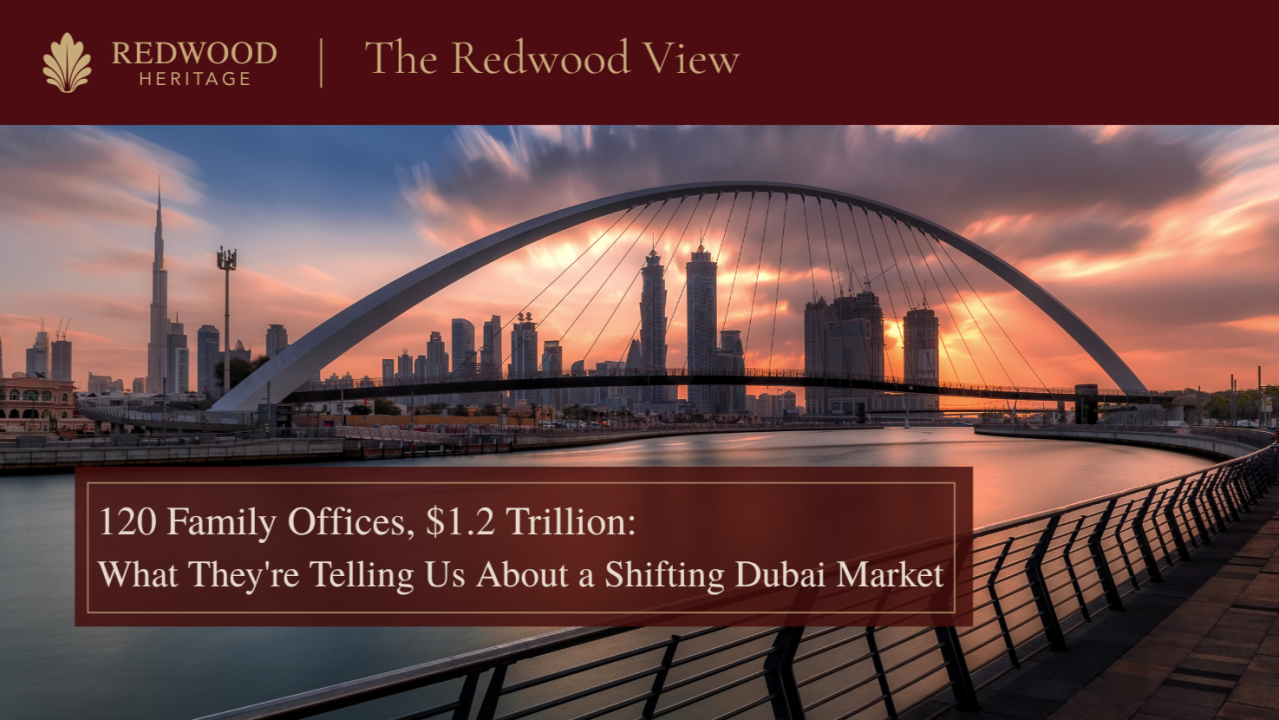
So we watch one group in particular. The Dubai International Financial Centre is now home to more than 1,250 family-related entities, and the top 120 families based there manage in excess of USD 1.2 trillion in assets globally. That figure is not a measure of money invested in Dubai real estate. It is a measure of something harder to fake: the calibre of capital that has chosen Dubai as the place to base, structure and govern its wealth.
This is the capital we watch most closely, and not from a distance. We do not infer its posture from the data. We hear it, first-hand, through our standing relationships with local and international family offices.
Capital of that nature does not move with the market it sits within. It does not chase momentum, and it does not reprice its conviction on one weak quarter. It repositions. How it repositions, now that the cycle has clearly turned, is one of the more honest leading indicators available.
What We Are Hearing – Conversations, Not Commentary
This is not a shift we have only read about. It is one we are engaged in directly. Over recent months, across roadshows in Switzerland, France, Monaco and Italy, and in meetings that continued through the regional conflict rather than pausing for it, we have sat with local and international family offices who treat Dubai as a long-term base. That this capital kept meeting and kept allocating attention to Dubai while the region was under strain is itself worth recording.
Across those conversations, the change in tone is clear, and it is consistent enough across markets to be a pattern rather than an anecdote. A year ago, the prevailing question was access: how to participate in Dubai’s growth. Today, the question is discernment: which assets within Dubai will prove durable. Four concerns now recur with regularity, wherever the conversation takes place.
The first is income over capital growth. Families are focused on whether an asset generates real, sustainable rental income. The five-year repricing is acknowledged, but it is no longer the reason to buy. Yield that survives a softer market is.
The second is developer quality and delivery risk. With so much of the market sold off-plan, principals are scrutinising who is building, their record on delivery, and what happens to value after handover.
The third is exit liquidity and resale depth. The most patient capital is, in fact, the most focused on exit. Families are asking how readily an asset can be sold without a discount when buyers are fewer, because they are planning for a market that does not simply rise broadly.
The fourth is safety and stability relative to the region. Far from deterring this capital, the conflict sharpened Dubai’s appeal as a stable base. The comparison these families draw is not only with the immediate neighbourhood, but with Europe, where many of them also hold interests. Measured against the political, fiscal and security pressures now weighing on parts of Europe, Dubai still stands out, despite its recent challenges. And critically, the trust in its ability to recover remains strong. These conversations did not treat regional risk as a reason to retreat from Dubai. They treated Dubai’s stability, and its proven capacity to absorb a shock and move on, as the reason to consolidate there.
That last point captures the broader posture. These families have not become hesitant about Dubai. Several are consolidating more of their wealth base here, not less. What has changed is that they are doing so far more selectively: committed to the destination, exacting about the asset. They remain in the market. They are determined to be in it well.
When the most patient capital starts asking sharper questions, about income, delivery, exit and resilience, it tends to move before the published data confirms the change.
The Shift – From Buying Dubai to Buying Selectively
For most of the past five years, exposure to Dubai was a sufficient strategy. The market rose broadly, carried most assets, and the cost of being undiscerning was low.
That period is ending. Not gently, and not into something that rewards passivity. The market is moving from one in which buyers competed for access, to one in which sellers increasingly compete for committed buyers. Negotiations are lengthening. Asking prices are being tested, and increasingly, not met. For some assets, the adjustment ahead will be more punishing than the current data yet shows.
Broad exposure to Dubai no longer guarantees a good outcome, because the market is no longer moving as one. It is dispersing, and dispersion is the condition in which selectivity becomes the entire game.
This is what we believe the family-office posture is telling us. The most considered long-term capital is not exiting Dubai. It is becoming far more particular about what in Dubai it will own. The conviction has not weakened. It has narrowed, concentrating onto assets that can defend their value when the broad market is no longer doing the work.
Where Patient Capital Concentrates
If selectivity is the new discipline, the natural question is: selective toward what?
From what we observe, patient capital is concentrating on the qualities of an asset, not a list of locations. It favours liquidity: the confidence that an asset can be sold without a discount when buyers are fewer. It favours real income: sustainable rental demand, not projected yield on a launch brochure. It favours scarcity: supply that cannot easily be replicated. And it favours defensibility: the ability to hold value through a softer phase, rather than depending on a rising market to stay whole.
What this capital steps back from is the inverse: assets whose case rested on momentum, whose income story is unproven until handover, and whose supply is abundant. We will not label any single segment safe or unsafe; that judgement is asset-specific. But the direction of travel is clear. The premium is shifting from being in Dubai to owning the right thing in Dubai, and the gap between those outcomes is widening.
The Migration Engine – Demand That Does Not Pause
This is not a case for leaving Dubai, and that is the point worth holding. A market can be turning and still be structurally supported. The demand beneath Dubai has not paused, and that is what separates a market that is repricing from one that is unravelling.
The UAE was ranked the world’s foremost destination for millionaire migration in 2025, with net high-net-worth inflows of close to 9,800, ahead of every rival. More than 100,000 residencies have been granted to families of real estate investors under the Golden Visa framework, anchoring demand to residence rather than speculation. The forward signal is notable: a January 2026 survey found that 73 percent of family offices managing USD 500 million or more intend to establish UAE operations within eighteen months. Capital moving with that conviction does not unwind on one quarter’s drawdown.
Both things are true at once. The demand engine is solid and, by several measures, and by several measures durable. The market itself is repricing downward in real terms: asking preices are being cut, volumes have dropped, and selectivity is significantly rising. A market can be well-supported and still demand far more discipline from buyers than it did a year ago. That is where Dubai now sits.
Redwood Heritage View – Advisory in a Selective Market
For five years, the value of a real estate partner in Dubai was largely access: the ability to get clients into the market. In a broad bull market, access was enough.
It is no longer enough. When a market disperses, the cost of owning the wrong asset rises sharply, and the difference between a good decision and a poor one becomes a matter of selection, not timing. This is the environment in which advice earns its value: not in the easy years, but in the demanding ones.
Our role is not to tell clients that Dubai is without risk. No serious market is, and we have consistently declined to pretend otherwise. Our role is to help families separate the assets that are liquid, income-relevant and defensible from those that merely benefited from a rising market, and to position capital accordingly. The family offices we engage with are not asking whether Dubai is a good idea. They are asking which decisions, specifically, will hold. That is the right question, and answering it well is the whole of our work.
The opportunity in Dubai has not closed. It has changed shape. It is no longer the opportunity to buy Dubai. It is the opportunity to buy Dubai well, and in a dispersing market, those are no longer the same thing.
The most patient capital in Dubai is not leaving. It is becoming selective. In the phase ahead, the advantage will belong not to those with the most exposure, but to those with the most discernment.
Sources : DIFC family-entity and AUM figures (DIFC Authority, 2025 to 2026); Henley & Partners Private Wealth Migration Report 2025; GDRFA Golden Visa investor-family figures (2026); family-office UAE-intent survey (January 2026).

