


From forgotten fringes to future frontlines, Etihad Rail is redrawing value, access, and investor priorities across the Emirates.
A New Definition of Location
In 2026, national rail arrives. 1,200 km. Eleven cities. A new definition of location.
At Redwood Heritage, we see more than movement. We see a revaluation of time, a redistribution of opportunity, and a redrawing of the map itself.
For decades, the UAE built global-class airports, six-lane highways, and deep seaports. But what it lacked was what many countries take for granted: a passenger railway. That changes now.
Sleek, high-speed, and fully integrated, Etihad Rail marks a historic shift in how the country moves and how investors must now think about placement, connectivity, and timing.
This beyond a simple transport upgrade. It’s an infrastructure-led transformation of the entire value framework. And as with every real estate cycle shift, those who align early will define the next horizon.
Why It Matters
Car culture has long defined the UAE. But roads are saturated, emissions are rising, and congestion now costs the economy over $7 billion annually. Transport makes up nearly a quarter of national emissions.
Etihad Rail is a direct response. It’s a national strategy wrapped in a rail line: one designed to reduce emissions, ease pressure on highways, and support a sustainable 2050 vision.
More than that, it represents an investment in mobility equity. For the first time, the UAE will offer consistent, fast, and climate-resilient movement across all seven emirates, not just for tourists, but for workers, families, students, and investors.
What does this mean for real estate? It means mobility is no longer a lifestyle factor. It’s a financial filter. One that investors cannot afford to ignore.
The Scale: National Reach, Strategic Precision
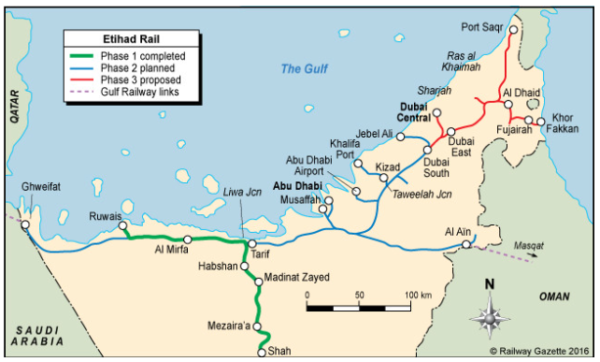
The rail line spans all seven emirates, links 11 cities, and will eventually connect to Oman and the broader GCC network. This is not incremental infrastructure. It’s foundational.
- 1,200 km of total rail
- 900 km of passenger track
- 36.5 million people moved annually
- 30-minute Abu Dhabi-Dubai route (in development)
- 47-minute Al Ain → Sohar (Oman) future link
It connects the Arabian Gulf to the mountains of Fujairah, making what once felt far now feel proximate. The Gulf becomes smaller. The map becomes flatter. And the value of time becomes more investable than ever.
Every major hub will eventually link into this system. That includes ports, airports, free zones, academic clusters, and industrial cities. As a result, mobility is no longer an amenity. It’s a macroeconomic asset.
Travel Times That Reshape Behaviour
Etihad Rail collapses not just distances, but decision-making logic:
- Abu Dhabi → Dubai: 50 minutes
- Dubai → Fujairah: 50 minutes
- Abu Dhabi → Ruwais: just over 1 hour
- Abu Dhabi → Fujairah: 1 hour 40 minutes
By comparison, car travel to Fujairah from Abu Dhabi today can exceed 3 hours during peak periods. With rail, that collapses into less than half the time – with zero congestion, emissions, or friction.
For the first time, buyers and tenants can truly choose lifestyle first, and commute second. For investors, this unlocks a recalibration of demand, value, and liquidity. It enables the market to operate on preference rather than proximity.
Strategic Stations, Real Value
Early stations are already announced:
- Sakamkam, Fujairah — Coastal access meets industrial scale
- University City, Sharjah — A hub for students, researchers, and renters
- Jumeirah Golf Estates — Established luxury meets national mobility
- Al Maktoum International Airport — The convergence of logistics, air, and rail
These aren’t just stops. They’re future anchors of value creation. In mature global cities, rail-linked districts command price premiums of 10% to 30%. In an emerging network like this, the potential uplift is even greater.
And because these stations are designed for full integration – with buses, taxis, and local mobility solutions – they will form the nucleus of what comes next: transit-driven masterplans with long-term resilience baked in.
Engineering Built for the Desert
Temperatures exceed 50°C. Sabkha soil behaves unpredictably. The solution? Elevated tracks, desert-grade causeways, sealed cooling systems, and 145 bridges and tunnels. This is infrastructure built for the Gulf, not imported and adapted.
Behind the scenes, the freight system is already live. Since 2016, it has moved over 3 million tonnes of cargo – removing 300 trucks from the roads for every train. This dual network of freight and passenger capacity enhances the long-term commercial appeal of every linked zone.
Redwood clients operating in logistics and industrial segments are already exploring portfolio adjustments aligned to these freight terminals, where value is not just in location but in throughput.
What It Means for Redwood Clients
As the national rail system reshapes the country, we see five clear shifts:
- Peripheral Zones Gain Central Value Locations previously considered fringe now have premium access. Expect recalibration, especially in Fujairah, Al Ain, and inland Sharjah.
- Commute Compression = Portfolio Diversification Lifestyle-first locations are no longer constrained by geography. This enables bolder asset allocation, especially for clients managing long-hold rental strategies.
- New Development Logic Developers will build around stations, not just skylines. These masterplans will prioritise footfall, flow, and flexibility – creating communities that thrive with or without a car.
- Yield Durability in New Nodes Transit-accessible rental corridors will become the bedrock of stable income strategies. Redwood modelling indicates 15–20% yield resilience uplift near stations over 10 years.
- Logistics Assets Revalued Proximity to freight nodes enhances land value, especially in locations with dual-mode (freight + passenger) utility. We are mapping those now.
Redwood’s Position
Our clients don’t follow hype. They follow signal. And Etihad Rail is a once-in-a-generation one.
We are advising select clients on:
- Securing early exposure near confirmed stations
- Vetting developers aligned with rail-integrated planning
- Building portfolios that balance yield with ESG upside
- Using mobility as a long-term hedge against obsolescence
- Navigating master developer frameworks and zone regulations that align with transit strategy
This isn’t just about opportunity. It’s about preparedness. And at Redwood, we exist to help clients not just react – but anticipate.
Final Word
Etihad Rail is more than a railway. It is a reordering of space, time, and return potential.
The UAE is about to move differently. So must capital.
Where capital flows next will not be defined by glamour alone. It will be shaped by access, integration, and time.
Redwood Heritage is not watching this shift. We are helping shape it. And we welcome strategic investors to move with us.

