


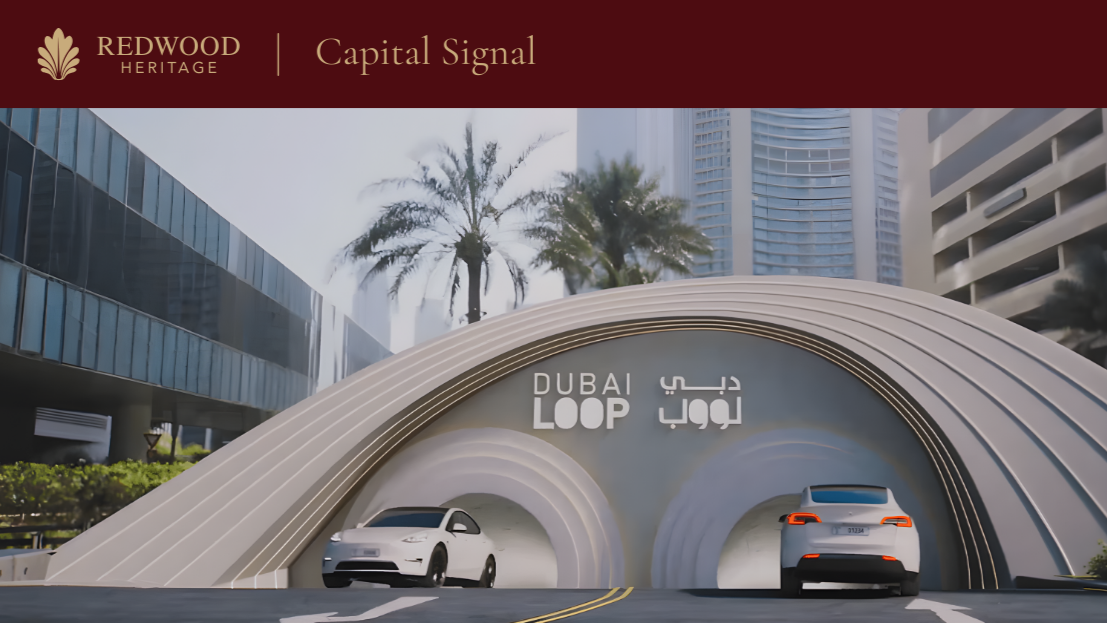
Dubai has launched the first phase of Dubai Loop, the underground transport programme being developed with Elon Musk’s The Boring Company.
The most important point is not the headline. It is that the project has moved into a defined first phase with stated scope, station count, and operating targets. That combination shifts Dubai Loop from a conceptual mobility idea into an infrastructure programme the market can begin to underwrite.
Phase 1 is set out as a 6.4 kilometre pilot with four stations, linking Dubai International Financial Centre with Dubai Mall and serving the wider Burj Khalifa area. In a city where the core is simultaneously a financial centre, a tourism engine, and a luxury lifestyle destination, that alignment is not incidental. It anchors the pilot in the corridor that already carries the highest concentration of institutional movement, premium footfall, and high value real estate.
The pilot is framed with an initial investment of around AED 565 million. The longer arc points to a broader network ambition with a total investment envelope of around AED 2 billion as Dubai Loop expands. At this stage, these figures should be read as guidance on intent and scale rather than finalised cost outcomes. What matters most for market pricing is not the estimate, but the sequence that follows: procurement clarity, construction mobilisation, and milestone delivery.
Structurally, Dubai Loop is designed as a system of dedicated underground tunnels built for vehicle transport. The tunnels are specified at a 3.6 metre diameter, a design choice that signals a pragmatic engineering approach. Smaller bore tunnels are presented as a pathway to faster delivery and lower disruption when compared with metro scale works, especially across districts where surface disruption carries a high economic and reputational cost.
This design framing is also a reminder that the Loop is not being positioned as a traditional rail project. It is being presented as a mobility layer that can be deployed quickly beneath existing infrastructure, designed to reduce interference with roads and utilities above. For a city that prizes uninterrupted function in its core, that point is central. Dubai is attempting to add capacity without slowing the city down to do it.
Operationally, Dubai Loop is being framed as station based. That distinction is essential. The network is not described as an open tunnel for private vehicles to drive through at will. It is framed as a managed service, where passengers enter at designated stations and take the system as a transport mode.
The demand framing attached to Phase 1 is explicit. The pilot is expected to carry over 13,000 passengers per day, while the expanded network is framed at around 30,000 passengers per day once built out. These should be understood as modelling targets rather than proven operating performance. Still, they matter because they indicate the intention to build something that is used daily. A system designed for daily volume is positioned as utility, not novelty.
And utility is where infrastructure begins to influence how the city works. If Dubai Loop delivers reliable movement through the core, it changes the tempo of the central districts. It alters the perceived distance between DIFC and Downtown. It makes certain commutes more predictable. It reduces reliance on surface traffic for key journeys. Over time, those changes become embedded in occupier decisions, hospitality patterns, and lifestyle choices.
The near term timeline language signals that this is not being parked as a distant idea. Tunnel work is expected to begin soon, and the programme is being discussed on a delivery horizon measured in years, not decades, with an expectation that later stages can accelerate once the first segment is operating.
In summary, the first phase launch of Dubai Loop provides the market with what it needs to pay attention: defined scope, clear station logic, measurable capacity targets, and a stated path to scale. For investors, developers, and occupiers, it is now a programme with parameters, not a concept without shape.
If you want to track Dubai’s next moves as they break, subscribe to receive Redwood Heritage Capital Signals and private market insights direct from our desk.

