


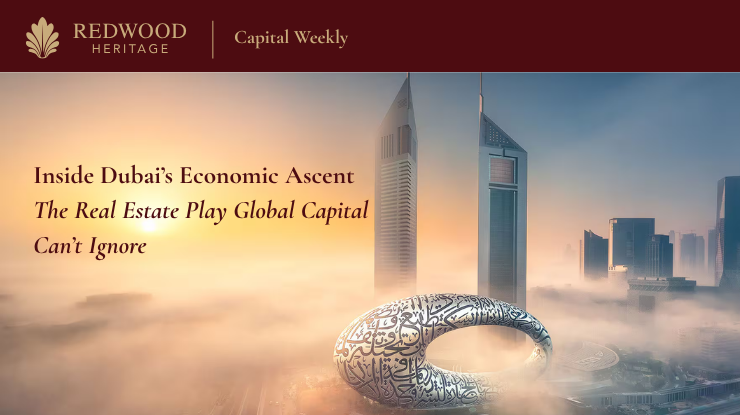
In an era defined by structural evolution and shifting global capital flows, the opportunity for discerning investors lies not in chance, but in alignment: linking your vision to the transformation of place and purpose. For Redwood Heritage – rooted in Swiss financial precision, legacy‑driven stewardship and a long‑term horizon – the emergence of Dubai’s real estate market stands not simply as a destination, but as a strategic vantage.
Dubai’s trajectory is guided by the Dubai Economic Agenda (D33), a bold ten‑year roadmap launched in 2023 which aims to double the emirate’s economy by 2033 and position it among the world’s top three economic cities. The ramifications for property markets are sweeping: infrastructure, trade, finance, talent‑migration, and urban‑fabric are all converging to reshape demand dynamics.
Concurrently, Dubai has elevated its standing in global finance: according to the latest edition of the Global Financial Centres Index (GFCI), the city now ranks within the top tier of global centres with one credible data point placing it at 12th globally. That ascent underscores the city’s shift from regional player to multi‑dimensional hub for investment management, fintech, professional services, global trading and real‑estate capital.
For real‑estate investors aligned with Redwood Heritage, this alignment is not coincidental but rather strategic. Because real‐estate is not merely about images of towers and beachfront villas; it is about the underpinning economic engine, the global talent flows, the institutional‑grade ecosystem, and the subtle value of being in a jurisdiction magnetising global HNWIs, funds and firms.
The D33 Agenda: Real Estate in the Engine Room
The D33 Agenda is bold in its ambition and rigorous in its trajectory. At its core it seeks to accelerate Dubai’s economy, not simply through one‑off projects, but by creating a connective ecosystem of trade, talent, technology and capital.
D33 seeks to shape a new phase of maturity for the emirate: not through isolated flagship projects, but by weaving a cohesive ecosystem where trade, talent, technology and capital flow seamlessly.
Our analysis, grounded in official frameworks identifies three central pillars of this transformation:
- Doubling GDP by 2033, fuelled by a sharp increase in foreign trade, inbound investment, and value-added economic activity.
- Positioning Dubai as a global business and innovation hub by drawing international talent, scaling high-growth sectors, and magnetising global capital.
- Laying the structural groundwork such as infrastructure, logistics, institutional regulation, and urban planning all required to support this elevation over the long term.
For real estate valuations, these are not peripheral but rather very central. In fact, the D33 agenda aims to significantly boost demand and investment in Dubai’s real estate by fostering overall economic growth, attracting talent and businesses, and promoting infrastructure development.
Indeed, the latest figures reveal a decisive structural shift: in 2024 the market recorded AED 761 billion (USD 207 Bn)in real‑estate transactions in Dubai, representing a 20 % year‑on‑year increase in value and a 36 % rise in transaction volume.
For the global investor, the message is clear: this is no speculative flash but a tangible structural re‑set.
Dubai’s Financial Centre Momentum – and What It Means for Property
Often overlooked by real‑estate investors is the significance of the financial‑centre backdrop. A city that attracts fund‑flows, institutional investors, global trading desks and service platforms calls for residence, office space, logistics, lifestyle infrastructure and capital‑markets depth. That is precisely what Dubai is building.
In its latest edition of the Global Financial Centres Index (GFCI), the City of Dubai is recognised among the elite group of cities designated as “Global Leaders – Broad & Deep”, meaning it demonstrates both breadth and depth across the full spectrum of financial services. Further, Dubai is now ranked 5th globally for FinTech specifically – while placing 6th in professional services, 8th in investment management, 13th in trading and 14th in banking/finance.
Why this matters to real‑estate investors:
- Capital flows: Being a global financial centre drives inbound capital, including private‑wealth, institutional mandates and corporate allocation – demand which often finds expression in prime real‑estate.
- Talent and migration: Global firms locate talent hubs in cities with strong finance ecosystems by creating sustained demand for residential, office and ancillary infrastructure.
- Institutional‑grade property opportunities: Logistics, data centres, premium offices, co‑live/co‑work spaces – these are derivative of a financial hub, and Dubai is layering them in.
- Credibility and stability: Rankings matter. For global investors accustomed to established hubs (London, New York, Zurich, Singapore), seeing Dubai ascend provides comfort around governance, regulation and long‑term competitiveness.
In short: the real estate story is deeply connected to the broader narrative of civic transformation and capital‑market evolution. For Redwood Heritage’s audience – those seeking structural allocation, not speculative exposure – that distinction is crucial.
Real‑Estate Implications: Where the Opportunity Lies
From a strategic viewpoint, real‑estate in Dubai must be seen across multiple segments:
- Prime residential: With affluent individuals and family offices relocating or expanding their presence, demand for high‑end residences, waterfront villas and luxury apartments is growing.
- Institutional/logistics/industrial: Under D33, trade corridors and logistics become priority. Industrial properties such as warehousing, data centres, fulfilment hubs all becomes a second pillar of value.
- Mixed‑use and lifestyle hubs: The convergence of finance, talent, lifestyle and infrastructure drives demand for integrated living‑working ecosystems – places that combine residential, leisure, retail and office in one ecosystem.
- Off‑plan and growth‑corridor development: Emerging growth zones such as Dubai Maritime City, Jebel Ali, Dubai South and Palm Jebel Ali are positioned to benefit.
From the supply side, scale is now sufficient for the market to shift from cyclical to structural. According to the Dubai Real Estate Sector Strategy 2033, the sector is targeted to double its contribution to Dubai’s GDP to approximately AED 73 billion and raise the total market value to AED 1 trillion. Beyond a simple milestone, this is a deliberate economic pivot. For global real‑estate investors aligned with Redwood Heritage’s ethos, it signals a transition from opportunistic accumulation to strategic allocation in three enduring themes:
- Structural growth rather than short‑term momentum.
- Diversification of exposure: not simply luxury residences, but logistics, data‑centre, co‑work, lifestyle‑ecosystems.
- Geopolitical repositioning: Dubai serves as a spine between East and West, offering a gateway for international capital seeking exposure to MENA, Africa and Asia.
Redwood Heritage’s Perspective: Positioned for the Future
At Redwood Heritage, our approach is shaped by three principles: legacy, precision and strategic foresight. When we look at Dubai, these principles converge:
- Legacy: Dubai’s ambition under D33 aligns with long‑term horizons. This is not a boom‑and‑bust cycle but a decade‑long vision of repositioning.
- Precision: As Swiss‑inspired stewards, we evaluate not only headline metrics (GDP, trade, ranking) but the structural layers such as regulation, liquidity, governance and connectivity that underpin sustainable returns.
- Strategic foresight: We invest where capital is being allocated globally, where talent is relocating, where policy is supportive, where real‑estate intersects with innovation and finance. Dubai ticks each box.
In practical terms, our global investor clients are engaging through allocations that reflect these dynamics: luxury residential in global‑finance nodes, institutional logistic assets along new trade‑corridors, and mixed‑use platforms in growth‑zones aligned with D33’s infrastructure roll‑out.
Looking Ahead: The Next Decade to 2033
As we look toward 2033, several markers stand out for the real‑estate investor:
- Population growth and migration: Dubai’s resident population is projected to grow markedly under the D33 framework – creating demand for both primary and secondary residences.
- Infrastructure delivery: The development of logistic hubs, free‑zones, connectivity corridors will shift supply and demand geography.
- Capital‑markets sophistication: As Dubai’s financial centre evolves, so too will the real‑estate investment vehicles – REITs, fund‑of‑funds, co‑investment platforms.
- Global wealth flows: As capital seeks life‑friendly locations with favourable tax, regulation and lifestyle, Dubai emerges as a magnet.
- Risk‑adjusted returns: For investors focused on downside protection and long‑term value, Dubai’s push from regional to global shift provides a front‑row seat.
Conclusion
In a world where global capital is increasingly discerning, real‑estate investment demands more than strong yields or glamorous facades – it demands strategic depth, jurisdictional clarity and future‑proof alignment. Dubai now offers such alignment: a jurisdiction actively repositioning itself, a policy framework that is coherent and credible, and infrastructure and finance ecosystems that are mature and evolving.
For Redwood Heritage’s global investor community, Dubai is thus not a speculative sidelight but rather a very strategic node. The play is not simply about buying real‑estate, but about participating in a transformation that joins vision, economics and place.
If you would like to explore how Redwood Heritage is deploying real‑estate capital in Dubai -across prime residential, institutional platforms and mixed‑use growth asset- please connect with us. The next decade of Dubai’s ascent may well define the next generation of global real‑estate opportunities.

