


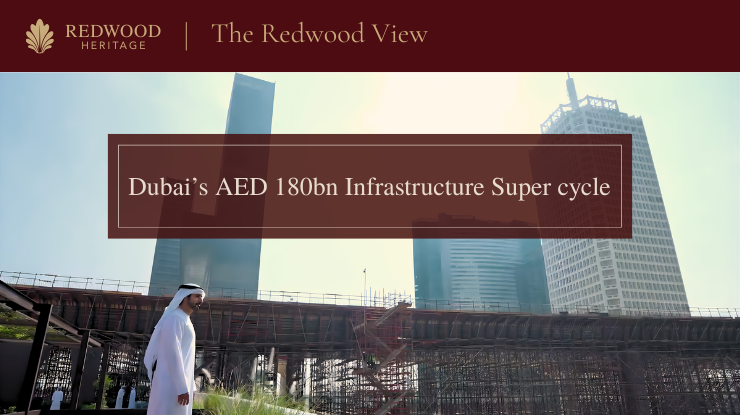
Engineering Reliability, Manufacturing Value
Dubai is not experiencing an infrastructure boom. It is executing an infrastructure system upgrade.
What distinguishes the current cycle is neither ambition nor pace since both have long defined the city, but scale deployed in parallel across economic, logistical, urban, and resilience layers. Financial districts, airports, national rail, metro systems, and climate-resilience assets are being advanced concurrently, not sequentially. This is deliberate.
When viewed holistically, Dubai’s committed and ongoing infrastructure programme represents well in excess of AED 180 billion in formally announced projects, excluding multiple road, utilities, port, and district-level works that sit outside headline announcements. This capital is not being spent to stimulate growth. It is being deployed to engineer reliability, compress time, and reduce friction for global capital, talent, and commerce.
For long-horizon real estate investors and family offices, this distinction matters. Infrastructure in Dubai is not a response to demand; it is the architecture that manufactures demand durability.
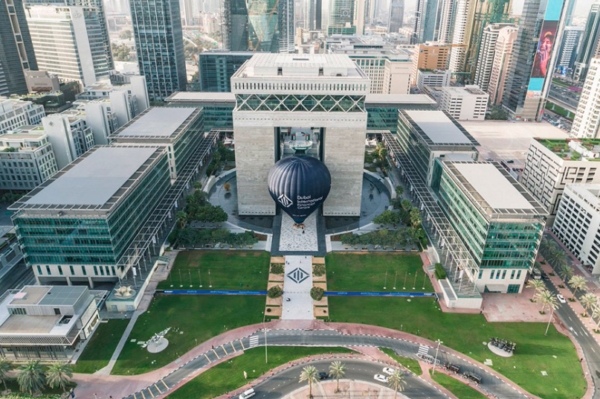
The Institutional Core: Dubai International Financial Centre Expands Like a City
Infrastructure sequencing reveals intent. Dubai begins with its financial core.
The expansion of the DIFC through the Zabeel District which is publicly valued at USD 27.23 billion, with phased delivery extending toward 2040, is not a real estate project in the traditional sense. It is an institutional bet on capital markets depth, corporate density, and regional financial leadership.
Financial districts expand when a city anticipates not just growth, but complexity. More funds, more structures, more cross-border mandates, more governance. These activities demand proximity, legal infrastructure, and human capital density. DIFC’s expansion therefore precedes residential repricing, not the other way around.
For real estate, the implication is structural. Financial districts create inelastic demand for Grade A office space, premium residential catchments, hospitality, and lifestyle services. They anchor liquidity because institutional occupiers return repeatedly, across cycles.
Dubai is effectively widening the base of its economic pyramid before adding height. That is how cities de-risk their future.

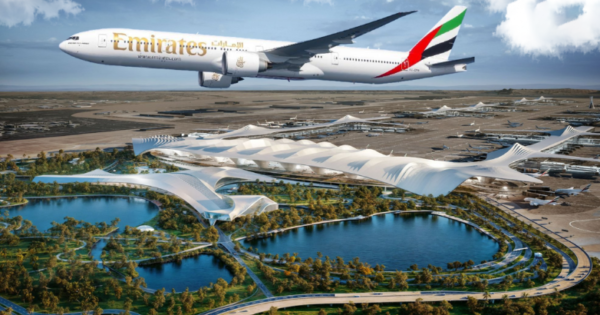
Aviation as Economic Gravity: Al Maktoum International Airport
If DIFC is the core, aviation is the force field.
The expansion of Al Maktoum International Airport at Dubai World Central represents one of the most ambitious aviation infrastructure programmes globally. With announced capital expenditure of approximately AED 128 billion, the airport is designed to ultimately handle up to 260 million passengers annually, alongside substantial cargo capacity.
Beyond tourism, Al Maktoum International Airport is a platform city strategy.
Airports of this scale reshape economic geography. They attract logistics, advanced manufacturing, corporate headquarters, high-frequency business travel, and specialised services. Over time, employment nodes shift, residential corridors realign, and entire districts mature around connectivity rather than sentiment.
For real estate investors, aviation infrastructure should be read directionally, not locally. The value does not accrue to the runway. It accrues to corridors that compress access between economic engines, and to assets positioned where global mobility intersects with daily life.
Dubai understands this dynamic. DWC is not being expanded in isolation; it is being integrated into a broader mobility and logistics lattice.
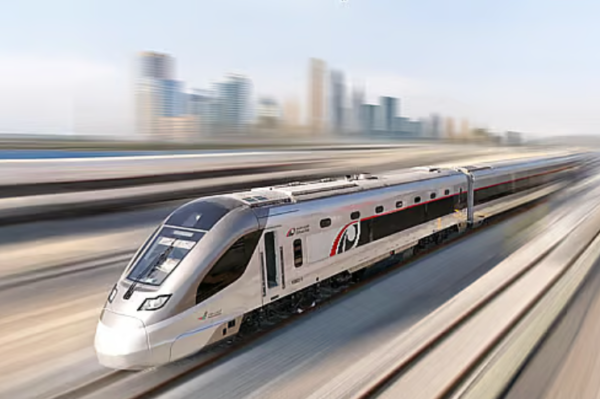
National Productivity: Etihad Rail
Where aviation connects Dubai to the world, Etihad Rail integrates the UAE internally.
The national rail network is fundamentally a freight and productivity project. By linking ports, industrial zones, logistics hubs, and neighbouring emirates, Etihad Rail reduces time-cost, improves supply chain reliability, and enhances the competitiveness of land-intensive sectors.
Real estate impact here is often misunderstood. Rail does not immediately reprice residential assets. It first restructures industrial, logistics, and warehousing economics, which then feed employment stability and income generation. Residential demand follows productivity, not infrastructure announcements.
For long-term investors, national rail represents a quiet but powerful stabiliser. It supports diversification away from purely consumption-driven growth and anchors demand in trade, industry, and regional integration.
In infrastructure terms, Etihad Rail is the connective tissue that ensures Dubai’s urban growth is supported by national economic throughput.
Urban Time Compression: Dubai Metro Blue Line
Only after global and national systems are addressed does Dubai expand urban mobility.
The Dubai Metro Blue Line, awarded at AED 20.5 billion, will extend the network by approximately 30 kilometres with 14 stations. This is not about moving more passengers; it is about manufacturing time.
In real estate, time is value. A reduction of ten minutes in daily commute expands liveable catchments, increases labour market flexibility, and raises the financeability of land. Metro infrastructure converts optional locations into viable ones, and viable locations into liquid markets.
Historically, Dubai’s metro expansions have done three things consistently:
- Reduced pricing volatility in connected districts
- Improved rental absorption during supply cycles
- Increased lender comfort, supporting leverage availability
The Blue Line should be understood in this context. It is an urban efficiency tool designed to support density without sacrificing liveability – a prerequisite for sustainable city growth.

Continuity and Resilience: Tasreef
Infrastructure cycles mature when they address not just growth, but continuity.
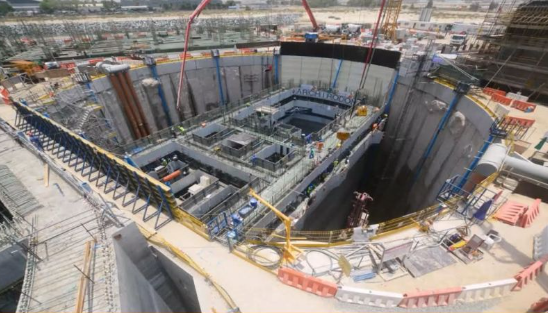
Dubai’s Tasreef programme, announced at AED 30 billion, aims to expand rainwater drainage capacity across the emirate by up to 700 percent. Alongside broader sewerage and utility upgrades, this marks a shift toward climate-resilient urban design.
For real estate investors, resilience infrastructure is often invisible — until it fails. Markets silently discount assets exposed to operational disruption, even when headline yields appear attractive.
By investing system-wide rather than reactively, Dubai is reducing tail-risk. This supports what Redwood Heritage describes as the continuity premium: assets in environments perceived as reliably maintained tend to exhibit stronger liquidity, tighter pricing spreads, and greater resilience during stress periods.
Resilience is no longer a soft factor. It is balance-sheet protection.
Reading the Stack: Why Parallel Execution Matters
What makes this cycle exceptional is not individual projects, but simultaneity.
Financial districts, airports, national rail, metros, and drainage systems are being built together. This creates compounding effects:
- Mobility enables density
- Density supports institutional depth
- Institutional depth attracts global capital
- Capital justifies resilience investment
- Resilience lowers risk premiums
This is how cities move from growth stories to allocation destinations.
Dubai is effectively signalling that it intends to remain investable not just in expansionary environments, but across regimes.
The Redwood Heritage View
Infrastructure does not guarantee returns. But well-sequenced infrastructure dramatically improves the odds.
Dubai’s current infrastructure programme is less about speed and more about engineering reliability at scale. By upgrading its operating system across economic, logistical, urban, and environmental layers, the city is reducing friction for capital and increasing the durability of demand.
For investors and families, the implication is clear. The opportunity is not in broad “Dubai exposure”, but in asset selection aligned with the city’s engineered vectors — where access, continuity, and institutional gravity are improving simultaneously.
In such environments, real estate ceases to be a cyclical trade and becomes what it should be: a long-duration claim on a functioning city.
The Redwood View offers strategic insight for global investors and family offices navigating real estate’s next chapter.

