


1. Introduction: Overture — A Palm Emerges
Between sea and sky, what once seemed impossible now feels inevitable.
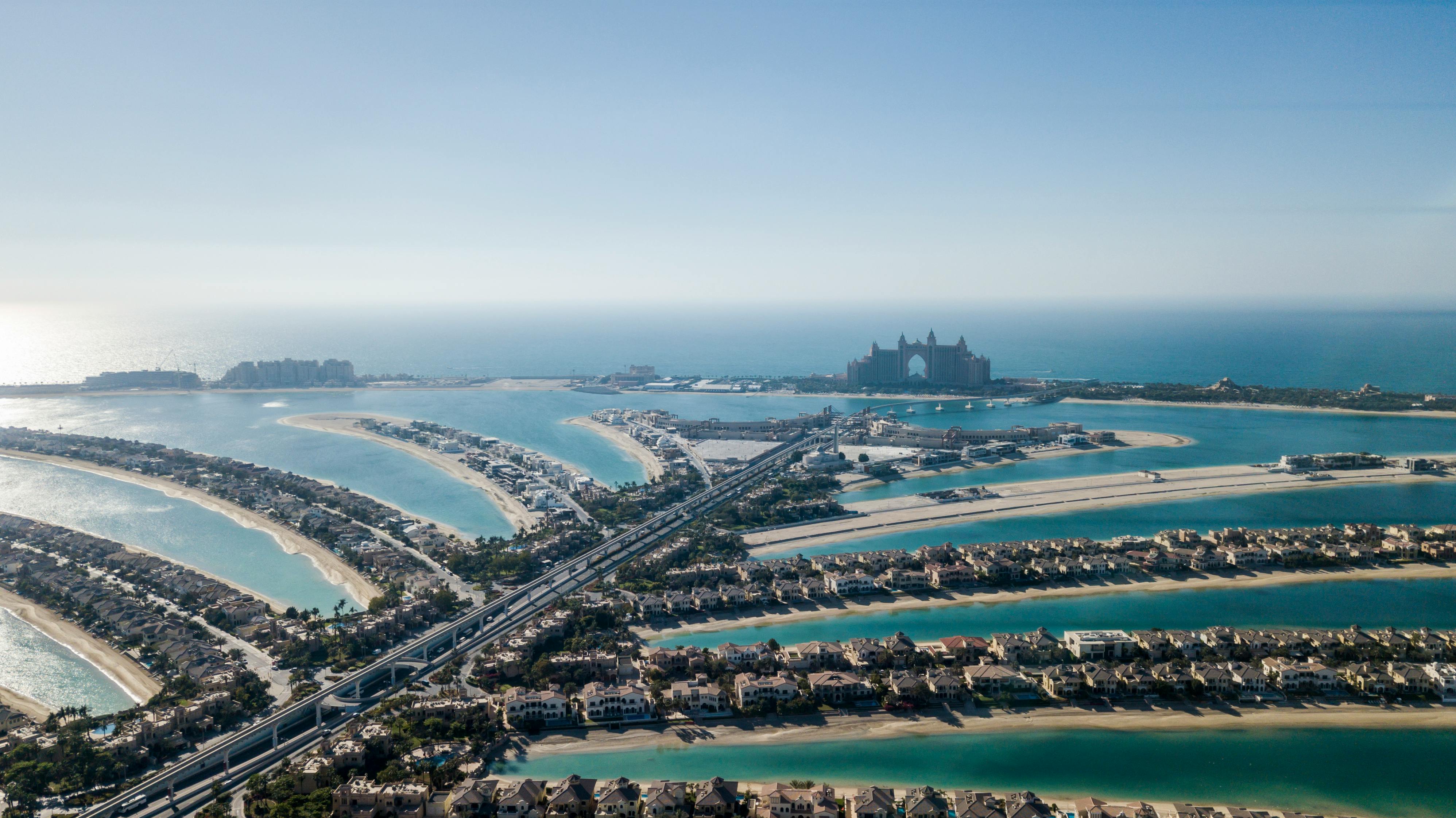
Palm Jumeirah was never meant to be subtle. Conceived at the dawn of Dubai’s modern ascent, it arrived not as a conventional development, but as a symbol: one of engineered grace, sovereign ambition, and geographic reinvention. Launched in the early 2000s and shaped from 94 million cubic metres of sand, the Palm was designed to offer something the city never had enough of — private coastline.
But over time, something unexpected happened.
The novelty matured. The spectacle softened. What began as a global curiosity slowly evolved into one of the most quietly coveted residential enclaves in the world. Today, Palm Jumeirah stands not simply as a feat of engineering, but as a sanctuary — discreet, enduring, and architecturally significant. A place where wealth lives not in exhibition, but in stillness. Where permanence is sculpted in shoreline.
And while the archipelago’s silhouette is as recognisable as ever, its narrative has shifted. No longer the loudest address in the Gulf — it is now among the most sovereign.
This is the story of Palm Jumeirah’s last ten years.
Of capital that no longer seeks performance alone, but peace.
Of structure that does not chase attention, but earns it.
Of a destination that has become, in essence, a legacy.
2. Into the Tide (2015–2020): From Curiosity to Credibility
By 2015, the Palm was no longer new — but it was not yet understood.
The engineering triumph had already drawn global headlines. Villas had sold. Hotels had opened. But for many global investors, Palm Jumeirah was still a question mark — too bold to ignore, too early to measure. Some called it theatrical. Others, speculative. The architecture was real, yes — but was its value?
Over the next five years, quiet answers began to emerge.
A Slow Surge in Strategic Capital
Between 2015 and 2020, Dubai’s real estate market moved with measured confidence. Citywide, total real estate sales reached AED 72.5 billion in 2015. By 2020 — even amid a pandemic year — the total had risen to over AED 72.5 billion in Q4 alone, driven by sustained investor appetite and regulatory liberalisation (DLD).
Palm Jumeirah, however, began diverging from the citywide narrative.
Where other districts chased volume, Palm held steady. Transaction volumes were modest, but per-square-foot values remained resilient — a signal that those buying were no longer betting. They were holding. By 2018, average villa prices on Palm Jumeirah were already 2.4 times higher than Dubai-wide averages, with occupancy rates among the highest in the luxury sector (Knight Frank).
Infrastructure quietly matured:
- The Palm Monorail improved access.
- Nakheel Mall began construction (completed in 2019), adding lifestyle density to the trunk.
- Five-star hospitality offerings multiplied, from One&Only The Palm to Atlantis The Royal’s construction commencement — reinforcing the island’s resort-residence duality.
The Shift from Luxury to Legacy
What was once seen as exuberant became scarce.
What was once speculative became sovereign.
And what was once bought to flip began to be held with generational intent.
By 2020, global family offices were beginning to inquire not about availability — but about discretion, architectural lineage, and long-term tax positioning. And while transaction numbers remained below their future peaks, price resilience and low turnover signalled a turning tide.
This was the era when Palm Jumeirah quietly stopped being a spectacle — and started becoming a signal.
3. Momentum (2021–2025): Scarcity Finds Its Stage
The world changed. So did the Palm.
In the aftermath of global lockdowns and economic recalibrations, capital sought clarity. Investors no longer looked only for growth; they looked for resilience. Jurisdictions that offered stability, tax efficiency, and quality of life rose to the surface — and Dubai found itself unexpectedly centre-stage.
At the heart of this repositioning stood Palm Jumeirah.
Between 2021 and 2025, the island experienced its most pronounced phase of demand acceleration — not in volume alone, but in quality. The Palm ceased to be simply a luxury destination. It became an ultra-prime stronghold.
Transaction Velocity & Value Creation
In 2021, Dubai recorded AED 155 billion in real estate sales across nearly 50,000 transactions — a strong recovery from the volatility of the 2010s (DLD). But it was in the ultra-prime segment — properties priced above USD 10 million — that the shift was most stark.
By 2024, Palm Jumeirah accounted for:
- 36.3% of all USD 10M+ property transactions in Dubai,
- Leading the city in both volume and total transaction value.
In Q1 of 2025 alone, 34 properties on Palm Jumeirah sold above USD 10 million — totalling over USD 562 million in transaction value (Knight Frank, Reuters). This included one six-bedroom villa that had previously sold for USD 6.6 million in 2015 — resold in 2025 for USD 106.3 million, representing a compound annual growth rate of over 34% (BizToday, April 2025).
That is not market movement. That is value revelation.
A Record Year for Global Capital Inflow
While Palm’s sales volume grew, something more important happened: listings declined.
By 2025, the number of properties on the market priced above USD 10 million fell by two-thirds, down to just 460 listings across the city. The Palm, finite by design and architecture, became the epicentre of this scarcity. And in real estate, scarcity — not sentiment — defines legacy value.
Meanwhile, the UAE led the world in net millionaire migration, with an inflow of over 9,800 millionaires in 2025 alone — many of them electing Palm Jumeirah as their first or only residence in the region (Henley & Partners, Business Insider, 2025).
This wasn’t just about homes. It was about jurisdiction. Governance. Quality of life. Capital efficiency.
And in every metric — from per-square-foot pricing to ultra-prime liquidity — Palm Jumeirah delivered.
4. Markers of Legacy: A Living Infrastructure of Intent
For most of its early life, Palm Jumeirah was known for what it represented.
Now, it is prized for what it sustains.
Between 2021 and 2025, the island’s promise became embodied in its lived infrastructure — not just in luxury, but in continuity. This was the period when the Palm transcended mere desirability to become inhabitable heritage. What changed wasn’t just the view. It was the rhythm of living.
Anchors of a Self-Sustaining Island
Palm Jumeirah matured into a complete ecosystem — where life, leisure, and legacy coexist without compromise.
Key markers of permanence include:
- Nakheel Mall (opened Q4 2019): Now the retail and social anchor of the trunk, with over 300 outlets, cinemas, and dining. It brought true urban rhythm to a previously dispersed resort community.
- The Palm Monorail: Operational since 2009, but modernised and fully integrated into the island’s experience by 2024, connecting residents to the Gateway station and Nakheel Mall through sustainable transport.
- Hospitality as Heritage: The rise of branded residences and signature hotel-living hybrids — from Atlantis The Royal to One&Only The Palm — introduced a new typology: experiential ownership. Residences now arrive not just with square footage, but with fully integrated wellness, gastronomy, and concierge ecosystems.
- Architectural Cohesion: In contrast to Dubai’s skyline — bold but fragmented — the Palm evolved with a rare harmony. From the uniform lines of Shoreline Apartments to the flowing sculptural forms of upcoming projects like PASSO, the island reflects not just wealth, but taste.
- Security, Privacy, and Governance: A hallmark of the Palm’s appeal has been the silent presence of order — gated villa fronds, controlled trunk traffic, and low-rise orientation. It offers anonymity in a city otherwise celebrated for spectacle.
From Residency to Ritual
Most global luxury enclaves remain transient — bought, sold, passed through. But Palm Jumeirah has entered a different stage: residential permanence.
Families now reside across multiple generations. Global residents treat their Palm addresses not as seasonal pads, but as operational home bases — supported by top-tier international schools within 15 minutes, private healthcare, and full digital residency infrastructure.
The island’s population, while modest (approximately 25,550 as of 2023), is not just wealthy — it is anchored. And that matters. In real estate, value follows structure. But legacy follows ritual.
5. Tide of Wealth: The Human Capital
Architecture alone cannot sustain value. People do.
Over the last decade, what’s most notable about Palm Jumeirah isn’t only the buildings — it’s the humans who now inhabit them. Not passers-through, but place-makers. Not seasonal footfall, but rooted, intentional capital. The Palm has quietly become home to a new class of resident: sovereign individuals, mobile families, and legacy-oriented investors who see beyond exposure — to substance.
Between 2015 and 2025, the global wealth landscape shifted. Regulation, volatility, and saturation in traditional markets pushed affluent families to reconsider not just where they invest, but where they live. Few places offered the blend of safety, sunshine, capital efficiency, and architectural permanence that Dubai — and specifically Palm Jumeirah — could.
UAE: The World’s Wealth Inflow Leader
In 2025 alone, the UAE attracted an estimated 9,800+ millionaires, the highest net inflow globally — surpassing the United States, Singapore, and Switzerland.
(Source: Henley & Partners, 2025 Wealth Migration Report)
This isn’t a surge. It’s a strategic realignment.
- Over the past 10 years, the UAE has grown its millionaire population by 98%, reaching over 130,000+ HNW individuals as of 2025.
(Source: Knight Frank, Khaleej Times, 2025) - Dubai is now among the top five cities globally for UHNW homeownership, with Palm Jumeirah ranked as the most actively transacted ultra-prime enclave in the region.
(Source: Knight Frank, 2024)
And while other districts saw turnover, the Palm witnessed retention. Residents didn’t just arrive — they embedded. They took up Golden Visas. They redomiciled assets. They moved with families, staffed their villas, and redefined what “home” meant.
From Investment to Identity
Who are these new residents?
- Principals of family offices seeking jurisdictional neutrality
- Second-generation wealth from Europe, Asia, and the GCC seeking sun, structure, and succession planning
- Entrepreneurs and sovereign professionals who want the simplicity of zero tax, stability, and global access without sacrificing privacy
Palm Jumeirah offers them all of it — in a format no other city can match. The scale is intimate. The views are sovereign. The symbolism is understood. And the upside is no longer speculative — it’s institutional.
This is not about boom-and-bust buyers.
This is about global families choosing where their story continues.
And they are choosing the Palm.
6. What We Hold: The Case for Legacy
In the end, capital doesn’t seek noise. It seeks clarity.
By 2025, Palm Jumeirah is no longer a place investors ask about — it’s one they quietly commit to. The narrative has outgrown price-per-square-foot metrics. It has become about preservation: of time, wealth, and identity.
The Palm has done what very few engineered projects have ever achieved. It has turned geography into gravity.
Scarcity, Not Sensation
Let the data speak:
- By Q1 2025, Palm Jumeirah villas averaged AED 6,912 per square foot, among the highest in the world — with only 16 new villas delivered in the prior year.
(Source: Espace Real Estate, CBRE, 2025) - The number of Dubai listings above USD 10 million dropped by two-thirds over two years — while ultra-prime transactions on the Palm surged.
(Source: Knight Frank, Business Insider, 2025) - Rental yields on high-end Palm properties outperformed London, Paris, and Singapore — with 5–7% net annual returns common, even on beachfront assets.
This is not a market riding on trend. It’s a market insulated by selectivity.
No land reclamation project of its kind has sustained this level of demand, pricing power, and cultural recognition. Unlike most luxury quarters, Palm Jumeirah is not expanding. It is complete. And in real estate, completion is a competitive moat.
Architecture as Inheritance
Redwood Heritage clients do not think in quarters. They think in generations.
Palm Jumeirah’s appeal is not defined by launch headlines. It is defined by the lived experience of ownership: private beachfronts. Walkable autonomy. Discreet security. Elevated architecture. Institutional governance.
There is no need to explain what a Palm address means.
It already lives in the imagination.
That is the mark of a legacy asset.
And for the families who now own here — some through trusts, others through Golden Visas, many through multijurisdictional vehicles — the properties are not just shelter. They are anchors.
Anchors of capital.
Anchors of belonging.
Anchors of story.
7. A Quiet Invitation
Palm Jumeirah has evolved. It no longer needs to announce itself.
It doesn’t compete. It simply continues — to endure, to elevate, and to belong.
What began as an act of vision has become an architecture of permanence.
And for the few who understand legacy not as an inheritance but as a practice, the Palm is one of the rare places on Earth where real estate becomes something more: a story held in stillness, shaped by time, and worthy of passing on.
At Redwood Heritage, we do not market this story. We protect it.
We curate access, not offers.
We advise, discreetly — not loudly.
For those who are ready to explore how Palm Jumeirah aligns with your capital intent,
your architectural preference, and your long-term positioning — we are ready.
This is not just property.
This is the most coveted shoreline ever constructed.
And it is still holding space for those who understand what it’s worth.
To begin a private conversation about Palm Jumeirah — grounded in data, architecture, and strategic legacy — contact Redwood Heritage.
We offer tailored insight, access to off-market opportunities, and long-view capital alignment for those who value permanence over promotion.

